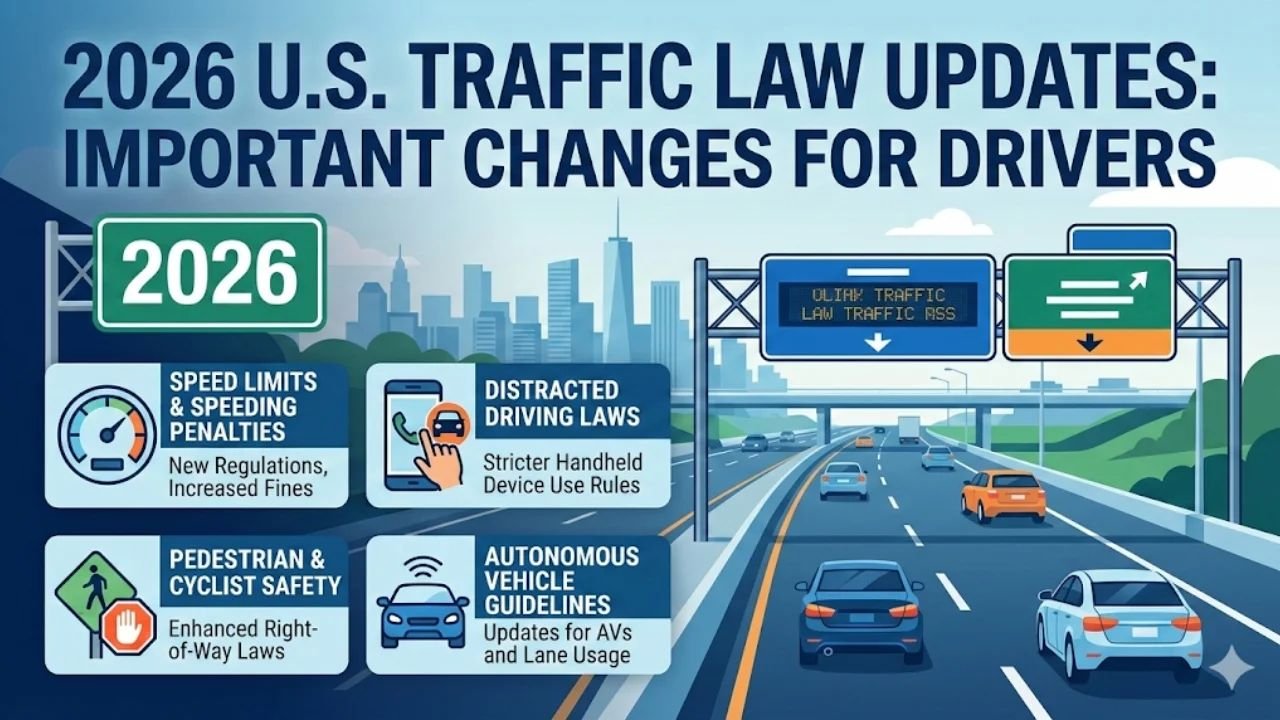
Road safety remains a top priority as U.S. authorities implement significant traffic law changes in 2026. These updates, driven by federal guidance from the National Highway Traffic Safety Administration (NHTSA) and state regulations, focus on reducing accidents, protecting roadside workers, and addressing distracted driving. For drivers, understanding these changes is essential—not only to avoid fines but also to help make roads safer for everyone.
With thousands of preventable crashes occurring each year, states are expanding protections and integrating new technologies to enforce safer driving practices. From move-over laws to automated speed enforcement and hands-free driving rules, 2026 introduces a new era of traffic compliance.
Expanded Move‑Over Requirements

The “Slow Down, Move Over” law is being extended across several states. Drivers are now required to reduce speed or change lanes when approaching any stationary vehicle displaying hazard lights, including disabled cars, tow trucks, utility vehicles, and construction zones.
States like California enforce AB390, which applies to highway maintenance crews, with fines up to $1,000 and potential civil liability for violations. Ohio, Pennsylvania, and Texas encourage proactive lane changes and reduced speed when maneuvering near hazard-lit vehicles. If a lane change is not possible, drivers should safely pass at no more than 5 mph below the posted speed limit.
Hands-Free Enforcement
Hands-free driving laws are becoming stricter in 2026, with primary enforcement allowing police to stop drivers solely for handheld phone use, even at red lights. First-time offenders face fines starting at $100, with repeated violations potentially leading to license suspension. Florida’s SB 1152 exemplifies this approach, permitting Bluetooth or integrated vehicle systems while prohibiting handheld use.

Key recommendations for drivers include:
- Using dashboard mounts for navigation.
- Leveraging voice-activated calls and media controls.
- Pulling over safely to interact with apps or information.
These measures have already contributed to a notable drop in accidents, according to NHTSA data.
Automated Enforcement and Vehicle Technology
Traffic enforcement in 2026 increasingly relies on technology. Speed and red-light cameras, as well as cell-phone detection systems, are being deployed in school zones, work areas, and high-crash locations. California’s SB 720 allows civil-only penalties via camera programs, while other regions implement average-speed monitoring to curb speeding in construction zones.

Meanwhile, NHTSA is promoting advanced driver-assistance systems (ADAS) in vehicles. Upcoming NCAP ratings include lane-keeping assistance and blind-spot alerts, while full Autonomous Emergency Braking (AEB), capable of detecting pedestrians up to 45 mph, will become mandatory for new vehicles by 2029. These systems are expected to save hundreds of lives annually.
Key 2026 Traffic Enforcement Changes
| Enforcement Change | Description | Example States | Typical Fine |
|---|---|---|---|
| Move-Over Expansion | Slow down/move for any hazard-lit vehicle | CA, IL, TX | $250–$1,000 |
| Hands-Free Primary Stops | No handheld phone use | FL, nationwide trend | $100–$500 |
| Speed/Red-Light Cameras | Automated ticketing in zones | CA, Midwest | $100+ |
| AEB/ADAS Mandates | Required advanced vehicle safety systems | Nationwide (phased) | N/A (manufacturer) |
| School Zone Limits | 20–25 mph reductions | CA | $100–$500 |
DUI, Emissions, and Vehicle Regulations
DUI enforcement is being strengthened with longer ignition interlock periods and extended probation for serious offenses. Roadside emissions sensors identify non-compliant vehicles without stopping them, imposing fines and encouraging EV adoption. Obscured license plates now carry $1,000 penalties, while autonomous vehicles are marked with ADS identifiers, and off-road e-motos require DMV plates. Low-income drivers may benefit from reduced parking fines under new payment schemes.
What Drivers Should Do
Drivers should adapt to these changes by installing hands-free devices, activating AEB where available, and maintaining situational awareness. Regularly checking DMV updates is essential, as state-specific variations exist. Defensive driving courses may also yield insurance benefits while enhancing safety. With U.S. road fatalities exceeding 40,000 annually, proactive compliance can reduce crashes and protect families.
FAQs
Q: Are move-over rules nationwide?
A: Coverage varies by state but expands to all hazard-lit vehicles in 2026.
Q: Are speed cameras everywhere?
A: They are concentrated in high-risk areas such as schools and work zones.
Q: When will new vehicles require AEB?
A: Full compliance will be phased in, with all new light vehicles mandated by September 2029.
By staying informed and adjusting driving habits, motorists can avoid penalties while contributing to safer roads across the country.